
Stainless Steel Chimney Cap: What Every Homeowner Should Know
RRoofpedia guidePublished November 21, 20261,436 words · 6 min read
Free tool
Compare roofing quotesPrice per square, side by side, and what each quote leaves out.A stainless steel chimney cap is a metal hood with mesh sides that sits over the flue opening. It keeps rain, animals, and debris out while letting smoke and combustion gases escape freely. The right cap, correctly sized and installed, does that job for decades without rusting out the way galvanized steel does.
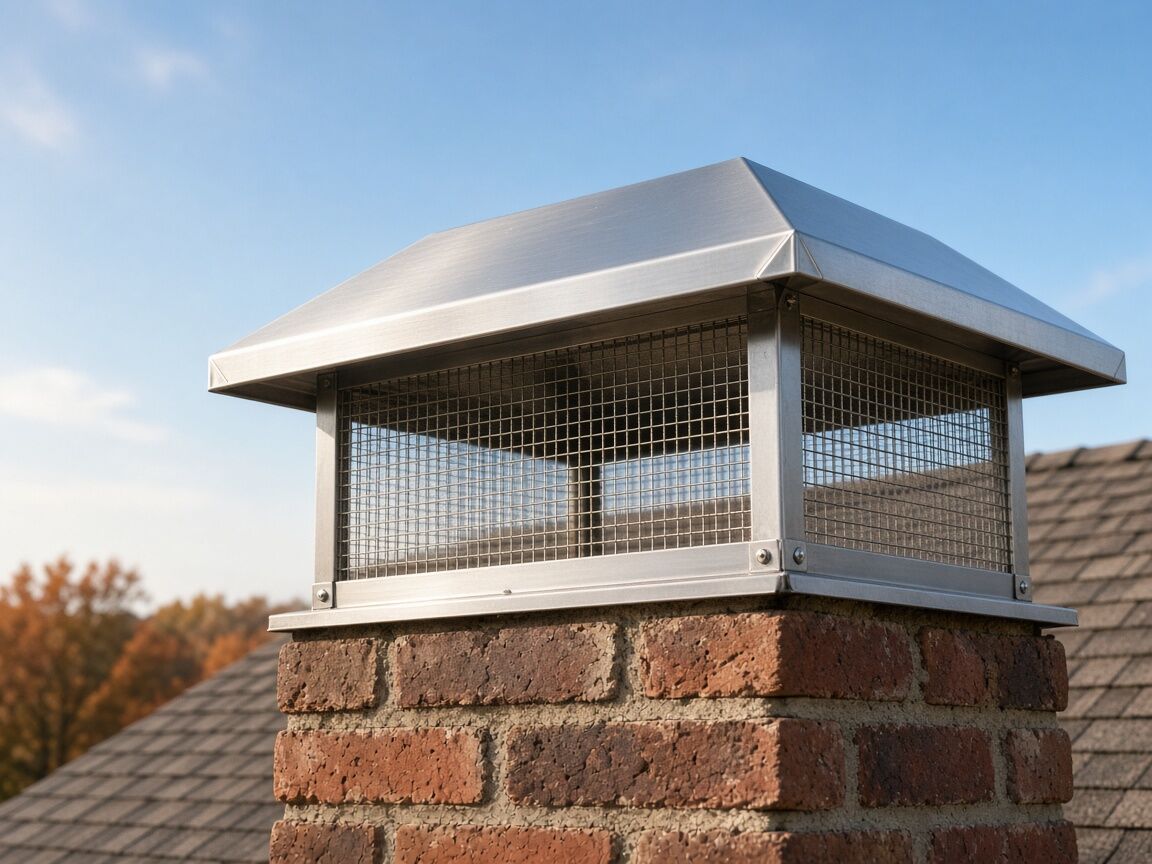
Picture made with AI for this guide.
What a stainless steel chimney cap actually does
The cap has two working parts: a solid hood that deflects rain and mesh sides that let gases out while blocking birds, squirrels, and debris from getting in. When rain hits an uncapped flue it soaks the liner, accelerates mortar decay, and can work into the firebox. Animals that nest inside create blockages that push combustion gases back into the living space.
In wildfire-prone areas the mesh also acts as a spark arrestor, catching embers before they land on a dry roof. The IRC at section R1003.9.2 specifies screen openings between three-eighths and one-half inch for that purpose and requires a removable design so the mesh can be cleaned.
One thing a cap cannot do alone: stop all water intrusion. The flashing where the chimney meets the roof, the masonry crown, and the mortar joints all carry equal weight. A cap handles the flue opening; everything else is a separate job.
304 vs 316 stainless steel: which grade do you need
Most caps sold today use 304 stainless steel, the standard grade for general residential use. It resists rust far better than galvanized steel, which corrodes relatively quickly near salt air. HY-C's 2026 manufacturer guidance specifies 304 stainless construction with defined gauges for the hood, mesh, and base across their single and multi-flue models.
316 stainless adds molybdenum to the alloy, giving it superior resistance to chloride pitting. If the house sits near the ocean or a salt-treated road corridor, 316 is worth specifying. Recent 2026 buying guides single out 316 for coastal applications for exactly that reason.
Gauge matters too. Heavier gauges such as 24-gauge stainless resist warping through freeze-thaw cycles better than lighter sheet metal. A cap that warps loses its seal and can rattle loose in wind. When comparing products, check the gauge of the hood and base separately, not just the mesh.
Single-flue caps, multi-flue caps, and chase covers
A single-flue cap clamps or bolts directly onto one clay tile or metal flue pipe. Measuring the outside dimensions of the flue tile is the critical step; a cap even slightly undersized will blow off, while one that is oversized gaps at the base and lets water in.
A multi-flue cap mounts to the chimney crown and covers two or more flues at once, suiting older homes where multiple fireplaces share one stack. Because it attaches to the crown rather than the flue itself, the crown must be in sound condition before installation.
Chase covers are a separate category. They sit on top of a factory-built chimney's wood-framed chase enclosure and shed water from that structure rather than capping the flue pipe directly. Stainless steel is a common material for chase covers because galvanized versions rust through and allow water into the chase framing.
Wind-directional and draft-inducing cap options
Standard caps work well when draft is normal. When a chimney smokes back into the house and downdrafts are the cause, a specialty cap can sometimes help.
Wind-directional caps use vanes that rotate to face away from the wind, keeping downdrafts from pushing back down the flue. Draft-inducing caps use a fixed shape that creates a low-pressure zone above the flue opening, pulling gases upward. Some models achieve this without moving parts, which matters for long-term reliability.
These caps are not a substitute for diagnosing the underlying draft problem. If the chimney is too short relative to the roofline or a nearby obstruction, a cap alone may not fully resolve the issue. A chimney professional can assess whether a specialty cap is the right fix or whether the chimney itself needs attention.
How to choose the right cap for your chimney
Start with fuel type. Stainless steel caps suit wood, pellet, oil, and coal-burning appliances. Not all galvanized options share that range, which is one more reason stainless is the default choice for most installations.
Next, measure carefully. Measure the outside dimensions of the flue tile or pipe at the top of the chimney, not from the ground and not from memory. Professional measurement is often recommended because even a small error leads to gaps, wind looseness, or interference with venting.
Then match the grade to the environment: 304 for most inland locations, 316 near salt air. Check the gauge, confirm the design includes both a solid hood and mesh sides, and verify the mesh opening meets local spark arrestor requirements if you are in a wildfire zone. Adjustable and bolt-on stainless models now cover a wide range of flue sizes, so finding a fit is rarely the problem; getting the measurement right is.
Care and upkeep: what to check and when
Stainless steel caps are not maintenance-free. Mesh collects soot, leaves, and in cold climates, ice. A clogged mesh restricts draft and can cause combustion gases to back up into the house. The National Fire Protection Association recommends annual chimney inspections that include checking the cap for damage or looseness, so build a cap check into that same visit.
Between annual inspections, look at the cap from the ground after any severe storm. Check whether it is still seated squarely, whether the mesh looks intact, and whether debris has piled against it. Binoculars help. Do not climb onto the roof to check unless you are trained and equipped for it.
If the mesh is visibly clogged or the cap has shifted, call a chimney sweep. A sweep can clean the mesh, reseat a loose cap, and check the crown and flashing at the same time.
When to call a pro instead of doing it yourself
Measuring and ordering a cap is something most homeowners can do from the ground. Installing it is different. Chimney work puts you on a roof, often near the peak, on a surface that may be steep or slippery. Any work at that height calls for a professional unless you have proper fall-protection equipment and training.
Installation errors have real consequences. A common mistake is installing a cap that restricts draft because the throat is too narrow for the flue's output. Another is using a mesh-only screen without a hood, which does nothing to keep rain out. A third is capping a chimney without first repairing a cracked crown, which lets water in around the base regardless of how well the cap fits.
A chimney professional measures, inspects the crown and liner, installs the cap correctly, and can document the work for insurance purposes. Get written quotes from more than one contractor, confirm they carry liability insurance, and ask whether a crown inspection is included in the scope.
Questions people ask
What size stainless steel chimney cap do I need?
Measure the outside dimensions of the flue tile or pipe at the top of the chimney. The cap must fit those dimensions exactly. Even a small error causes gaps or looseness in wind. Professional measurement is often recommended to avoid sizing mistakes.
Is 304 or 316 stainless steel better for a chimney cap?
304 stainless suits most inland homes and resists rust far better than galvanized steel. 316 stainless adds molybdenum for superior resistance to chloride pitting, making it the right choice for coastal or salt-air environments.
Does a chimney cap stop all water from getting into the chimney?
No. A cap covers the flue opening, but water also enters through cracked flashing, a damaged masonry crown, and deteriorated mortar joints. Those are separate problems that need their own repairs.
Do I need a spark arrestor chimney cap?
In wildfire-prone areas, local code often requires it. The IRC at section R1003.9.2 specifies mesh openings between three-eighths and one-half inch with a removable design for cleaning. Check your local code before buying.
How often should a stainless steel chimney cap be inspected?
The National Fire Protection Association recommends annual chimney inspections that include the cap. Also check it from the ground after any severe storm to confirm it is still seated and the mesh is clear.
Can a chimney cap fix a smoking fireplace?
A wind-directional or draft-inducing cap can help when downdrafts are the cause. It is not a fix for every smoking problem. A chimney professional should diagnose the draft issue first to confirm whether a specialty cap addresses the actual cause.
Read: Chimney Leaks and Chimney Flashing
Roofers near you
Papalocal lists 57,687 roofers. Search them by town.
Related guides
 Chimney Leaks and Chimney Flashing
 Rain Gutter Replacement: What You Need to Know
 Roof Contractors: What They Do and How to Choose One
Your business? Claim it free