
Drip Edge Flashing Explained
RRoofpedia guidePublished November 18, 2026801 words · 3 min read
Free tool
Try new gutters on your houseGutter colors against your roof and siding, in the house designer.Drip edge flashing is a corrosion-resistant metal strip nailed along the eaves and rakes of a roof. It pushes water off the edge and into the gutter instead of letting it wick back under the shingles or soak the fascia. The 2024 IRC requires it on every asphalt shingle roof.
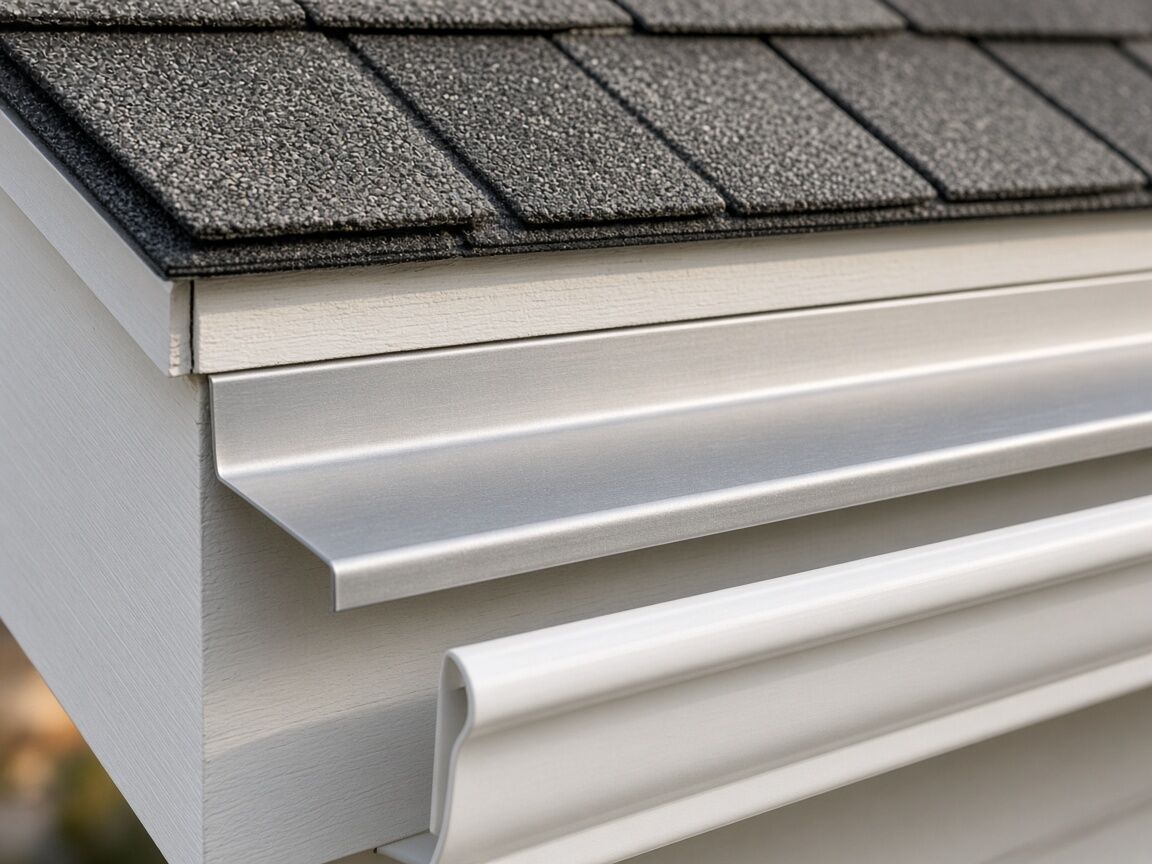
Picture made with AI for this guide.
What drip edge actually does
Water clings to surfaces. Without drip edge, surface tension pulls runoff backward under the last row of shingles and against the fascia board. Over time that moisture saturates the wood and rots the deck edge from below, often without any visible sign until the damage is serious.
Drip edge breaks that tension. The metal lip projects at least 1/4 inch below the roof sheathing, so water falls free and lands in the gutter rather than creeping along the wood. The flange that lays on the deck must extend at least 2 inches onto the roof surface. Wherever two pieces meet they overlap by at least 2 inches so no gap opens during thermal movement. Fasteners go into the deck no more than 12 inches apart, which also helps the edge resist wind trying to lift it at the corners.
The three common profiles and which to pick
Type C is L-shaped—simple, low-profile, and fits most standard reroof jobs where the existing geometry is straightforward. Type D is T-shaped; ARMA prefers it because the extra horizontal leg keeps water farther from the fascia face than the L-style does, reducing splash-back against the board.
Type F, called a gutter apron, has a longer lower leg that reaches deep into the gutter trough and delivers water well past the fascia. It is the practical profile when a contractor is adding gutters to an existing roof without tearing off shingles. The apron slides under the shingle overhang and directs water into the gutter without disturbing the finished roof surface. Knowing which profile suits the job keeps water moving in the right direction from the start.
Materials the code allows—and what it rules out
Aluminum, galvanized steel, and copper all qualify because they resist corrosion. The 2024 IRC sets a floor: at least 26-gauge galvanized steel or aluminum no thinner than 0.016 inches. Copper is acceptable when the rest of the flashings on the roof—valley, chimney—are also copper.
The 2024 IRC explicitly bars vinyl and plastic drip edge. Both lack the stiffness to hold their shape under heat and wind load. If a contractor proposes plastic, that is a code violation on any asphalt shingle roof.
Local amendments can tighten these rules. Florida's 2026 building code adds a 3-inch minimum lap and 4-inch fastening spacing for metal roofs. Louisiana's 2026 IRC amendments allow FORTIFIED standards—tighter laps, closer fasteners, and sealed joints—to govern on qualifying roofs. Always check what your jurisdiction has adopted.
The one install detail that trips people up
The underlayment sequence flips depending on where you are on the roof. At the eave, drip edge goes down first, then underlayment laps over it. That way water running off the felt drops onto the metal and into the gutter.
At the rake—the sloped side edges—the order reverses: underlayment goes down first, drip edge on top. That way wind-driven rain hitting the rake edge cannot get behind the metal and under the felt.
Getting this backward is one of the most common installation errors, and it is not visible once shingles are on. If a roof is being replaced, it is worth asking the contractor to confirm the sequence before underlayment is nailed off. Inspect existing drip edge for rust, holes, or sections that have pulled away from the deck; damage found during routine gutter cleaning is worth addressing at the next reroofing.
Questions people ask
Is drip edge flashing required by code?
Yes. IRC Section R905.2.8.5 requires drip edge at both eaves and rakes on asphalt shingle roofs. Some states have added stricter local rules on top of the base IRC language.
Does drip edge go under or over the underlayment?
At the eave it goes under the underlayment. At the rake it goes over. Reversing either one is a common mistake that can let water reach the deck or fascia.
Can I use vinyl drip edge to save money?
No. The 2024 IRC bars vinyl and plastic drip edge on asphalt shingle roofs due to insufficient stiffness and durability. Aluminum is the common low-cost compliant choice.
What is a gutter apron and when do I need one?
A gutter apron is the Type F drip edge profile. Its extended lower leg reaches into the gutter trough. It is the practical choice when gutters are added to an existing roof without removing shingles.
Read: Chimney Leaks and Chimney Flashing
Read: Gutter Repair: Options, How-To, and When to Call a Pro
Gutter cleaners near you
Papalocal lists 23,218 gutter cleaners. Search them by town.
Related guides
 Gutter Repair: Options, How-To, and When to Call a Pro
 French Drains: What They Are and How to Get One Right
 Gutter Guard Types Compared
Your business? Claim it free