
Gutter Guard Types Compared
RRoofpedia guidePublished November 2, 20261,459 words · 6 min read
Free tool
Try new gutters on your houseGutter colors against your roof and siding, in the house designer.Each gutter guard type fails in its own way: screens let small debris through, micro mesh clogs on its surface, reverse curve hoods overshoot in downpours and collect needles in their slot, and foam and brushes fill up and break down. Choose by what falls on your roof, how steep it is and who will clean the guards, because every type still needs cleaning.
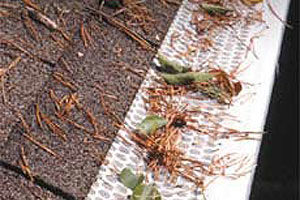
Micro mesh gutter guards: where they clog
A micro mesh guard is a fine stainless steel mesh stretched over a frame of aluminum or plastic, laid over the gutter and fastened at the front lip and at the roof edge. LeafFilter is the name many people know, and it is one micro mesh system among several. The mesh stops nearly everything solid, which is why it handles needles and shingle grit better than a screen.
Its failure happens on top, and slowly. Pollen, dust, roof grit and the fibers of oak tassels and seed wings settle into the weave and, after a season or two, form a felt that water skates across instead of dropping through. In a hard rain you see it as a sheet of water pouring off the front of the gutter, or as dirty streaks down the gutter face. Hooked or winged seeds wedge in the mesh and hold leaves around them.
The cure is cleaning the surface with a soft brush and a hose. Mesh that lies flat collects more than mesh tilted to follow the roof, and a frame that opens without lifting shingles is far easier to service.
LeafGuard and Gutter Helmet: how reverse curve hoods fail
Reverse curve guards cover the gutter with a solid hood whose front edge rolls downward. Water follows the curve into a slot underneath, and leaves ride off the edge. LeafGuard builds the hood into a one-piece seamless gutter, so it replaces your gutters; Gutter Helmet fits a hood over the gutters you already have. Both work the same way at the edge.
They fail in three ways. Surface tension has limits, so on a steep roof or in a cloudburst, fast water jumps the curve and misses the gutter entirely. Dirt, pollen and algae build up on the curved nose and break the film of water that should cling to it, so it drips off the front instead. And the slot admits needles, seed pods and grit that pile up inside where nobody can see them, leaving a packed gutter under a hood that looks clean.
Cleaning a hood system means scrubbing the nose, flushing the slot and, when the gutter is packed, taking hood sections off. Before buying, ask how the installer clears a clog inside and whether that visit is part of the warranty.
Gutter guards for pine needles, oak tassels and seeds
Match the guard to the tree, because each kind of debris defeats a different design. Broad leaves from maples and oaks are the easy case; nearly every guard sheds them, and hoods do it especially well. Small, hard and stringy debris is the hard case.
Pine needles vary. Long needles poke through screen openings and lodge there, half in and half out, catching more debris around them, while short spruce and fir needles drop straight through screens and into the slot of a hood. Only fine mesh keeps both kinds out of the gutter, and even then they pile up on its surface. Oak tassels arrive in a burst each spring and form a soggy blanket that blinds mesh faster than leaves do. Maple seed wings and sweetgum balls roll into hood slots and wedge in coarse screens, and seeds that reach a foam insert can sprout in it.
So under pines and oaks, plan on a mesh guard you can brush from a pole or ladder a few times a year. Under mostly big-leaf hardwoods, a hood or a sturdy hinged screen can be enough. With few trees nearby, ask whether you need a guard at all.
Roof pitch, valleys and heavy rain: when gutter guards overflow
How steep the roof is changes how a guard behaves. Water leaving a steep slope moves fast and reaches the gutter edge with momentum, so it can jump a hood's curve or race across mesh before it drains through. On a low slope the opposite happens: leaves and needles don't wash off the roof, they creep down and settle on the guard, where they hold water and rot.
Valleys are the trouble spot on almost any roof. A valley gathers rain from two slopes into one stream and drops it on a short stretch of gutter, and no guard drains that much water as fast as an open gutter. Installers often add a splash guard or valley diverter there. Watch the valleys during the first heavy storm after guards go on.
Winter brings its own test. A guard buried in snow and ice can't take in meltwater, which then runs over the front and freezes into icicles, and snow sliding off the roof can bend guards and strain the gutter hangers. In snow country, ask how a guard is fastened and rated for that load.
Gutter guard warranties and your roof shingle warranty
A guard sold with a no-clog warranty is worth reading closely. Find out what counts as a clog, whether debris lying on top of the guard is your job, and what the company does if the gutter does clog: send someone to clean it, refund part of the price, or neither. Ask whether the warranty passes to the next owner, whether it covers the gutters or only the guard, and what voids it, such as someone else cleaning or repairing them.
Your roof has its own warranty, and a guard can affect it. Shingle makers warrant their shingles against manufacturing defects, not against damage from products installed on or under them. Guards that slide beneath the first course lift shingles and break their seal, ones screwed through the shingles add holes, and shingles bent in cold weather crack. Damage caused that way generally falls outside the shingle warranty.
So on a roof with plenty of shingle warranty left, lean toward a guard that attaches to the gutter lip and the fascia or drip edge without touching the shingles, and get the attachment method written into the quote.
How to choose a gutter guard type for your house
Work through four questions. What falls on the roof, and when? A yard of maples calls for a different guard than a lot full of pines. How steep is the roof, and where do the valleys drain? What shape are the gutters in? Guards belong on sound gutters with good slope and tight seams; if yours are failing, new gutters with a guard, or a one-piece gutter and hood, may make more sense. And who will clean them? A guard you can brush from the ground suits an owner who won't climb, and a hinged screen suits a cleaning company.
Then weigh the price against plain cleaning, the test the original gutter guard guide on this site applies. The price moves with the guard type, the feet of gutter, the number of stories, the corners and downspouts, and any gutter repair or replacement it requires.
Get three quotes that name the guard type, the mesh or hood material, how it attaches, the feet covered and the warranty terms, so you are comparing the same thing.
Questions people ask
What type of gutter guard works for pine needles?
Fine micro mesh is the type that keeps both long and short needles out of the gutter. Needles still collect on top, so choose mesh that tilts to follow the roof and plan to brush it a few times a year under heavy pines.
Are LeafGuard and LeafFilter the same thing?
No. LeafGuard is a one-piece seamless gutter with a reverse curve hood built in, so it replaces your gutters. LeafFilter is a micro mesh guard fitted over existing gutters. They stop debris in different ways and fail in different ways.
Do gutter guards cause ice dams?
No. Ice dams form on the roof when heat escaping from the attic melts snow that refreezes at the cold edge. A guard can hold snow and ice at the gutter, though, so ask how a guard handles winter where you live.
How do you clean micro mesh gutter guards?
Brush the surface with a soft brush from a ladder or on an extension pole, then rinse from above with a garden hose so the film washes through. Skip the pressure washer, which can drive debris into the mesh, and check that each downspout still drains.
Gutter cleaners near you
Papalocal lists 23,203 gutter cleaners. Search them by town.
Related guides
All gutters guides

Your business? Claim it free