
French Drains: What They Are and How to Get One Right
RRoofpedia guidePublished November 5, 20261,403 words · 6 min read
Free tool
Try new gutters on your houseGutter colors against your roof and siding, in the house designer.A French drain is a gravel-filled trench with a perforated pipe that collects groundwater and carries it away from your foundation, yard, or basement by gravity. Water seeps through the gravel, enters the pipe, and flows to a discharge point such as a pop-up emitter, dry well, or storm drain. Getting the slope, gravel, and fabric right determines whether the system works for decades or clogs within a few seasons.
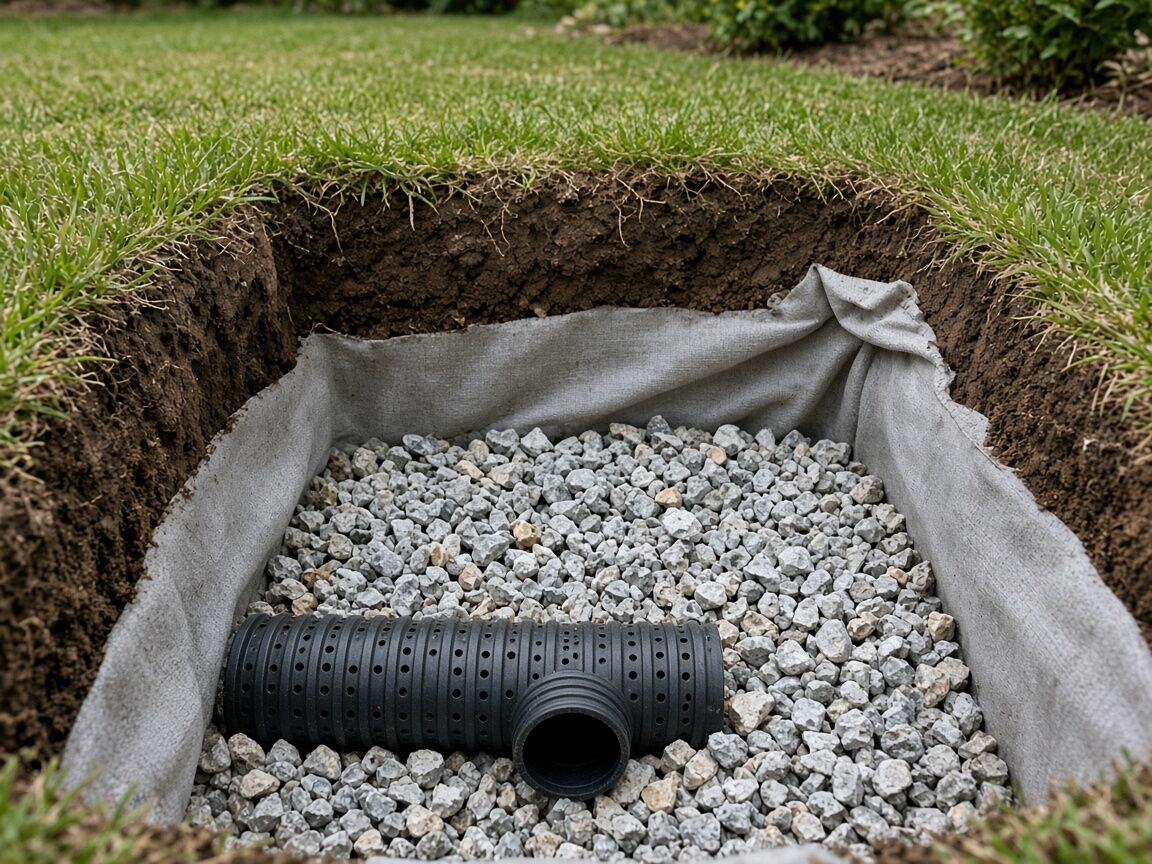
Picture made with AI for this guide.
What a French drain actually does
Think of a French drain as a buried channel that intercepts water before it reaches somewhere you don't want it. The trench fills with coarse crushed stone, a perforated pipe sits inside that stone, and landscape fabric wraps the whole assembly. Water moving through the soil finds the gravel long before it finds your foundation wall.
Gravity does all the work. Water seeps through the gravel and drops into the perforated pipe through holes typically positioned facing downward, so the pipe draws from the bottom of the trench rather than the top. From there the pipe carries the flow to a discharge point at a lower elevation. Without a legal lower outlet, the system only moves the problem somewhere else on the same property rather than removing it.
The fabric lining is not optional. Its job is to keep fine soil particles from migrating into the gravel and slowly filling the voids that make the whole system work. Once those voids close, water has nowhere to go and the drain fails quietly underground where you can't see it happening.
How the pipe, trench, and slope are sized
Most residential installations use four-inch perforated PVC or corrugated pipe in a trench twelve to twenty-four inches deep and six to twelve inches wide. PVC holds its shape under soil load; corrugated pipe is lighter and easier to route around obstacles, though it can flatten if backfilled carelessly.
Slope is non-negotiable. The pipe needs at least one inch of drop for every eight feet of run to keep water moving by gravity alone. A flatter run lets sediment settle inside the pipe and build up over time. When the site doesn't offer enough natural fall, the installer has to engineer the outlet elevation before the first shovel goes in.
Gravel selection matters more than most homeowners expect. Washed, crushed stone in the three-quarter-inch to one-and-a-half-inch range gives water room to move and doesn't compact the way smaller material does. Pea gravel looks similar but its rounded shape and finer sizing allow it to migrate and pack — a common and costly mistake.
French drain types: exterior, interior, and curtain drains
An exterior footing drain runs along the outside of the foundation at footing depth. It's the right choice when the water table is high or when groundwater is pressing directly against the foundation wall. Because it requires excavating down to the footing, it's the most disruptive option, but it addresses the problem at its source.
An interior perimeter drain runs inside the basement along the base of the foundation wall. It doesn't stop water from entering the wall, but it captures seepage before it spreads across the floor and routes it to a sump pump. Contractors use it when the lot is too tight for exterior excavation or when an exterior system has already failed.
A curtain drain sits uphill from the house and intercepts surface runoff and shallow groundwater before it reaches the structure. It's the right tool for a sloped lot where water sheets toward the house during rain rather than rising from below. Curtain drains are often shallower than footing drains because they're catching moving surface water, not intercepting a high water table.
Pop-up emitters: the discharge end of the system
A pop-up emitter is the most common discharge choice for residential French drains. The cap stays closed when the pipe is dry, keeping rodents and debris out. When water pressure builds behind it, the cap lifts and flow releases at grade.
NDS and other manufacturers now offer twelve-inch pop-up emitters designed for higher-volume situations — systems serving multiple downspouts or long French drain runs that collect a large catchment area. Matching emitter capacity to the volume the system carries prevents backpressure that slows drainage during a heavy storm.
The emitter needs a clear path to daylight. Grass and mulch can grow over the cap and hold it shut. Checking that the cap opens freely takes about thirty seconds and is one of the simplest maintenance tasks on the whole system. The outlet should also discharge well clear of wells, leach fields, and any wetland boundary — local building departments set the specific rules.
What makes one installation cost more than another
Trench depth drives labor hours more than almost any other factor. A shallow curtain drain in loamy soil moves quickly. A footing drain going deep through clay, then navigating around a buried utility line and an old concrete footer, is a different project entirely.
Soil type changes equipment and time. Clay holds its shape but resists the shovel; rocky soil may require a breaker. Soft sandy soil can collapse trench walls before the pipe goes in. The outlet run adds length and cost — if the nearest legal discharge point is a storm drain at the street, the pipe has to travel that full distance, often under a driveway or sidewalk.
A written quote is the only way to know what a specific site will cost, because no two yards combine depth, soil, obstacles, and outlet distance the same way.
Maintenance schedule and when to call a pro
Check the discharge outlet every fall before the ground freezes and every spring after it thaws. Debris, soil, and grass can block the emitter cap between inspections. Clear anything that has grown over it and confirm the cap opens by hand.
Flushing the pipe from a cleanout every couple of years dislodges sediment that has settled inside. Every several years, watch how the system performs during a heavy rain — water that used to drain now sitting longer is an early sign the gravel voids are filling.
Call a drainage contractor when the system stops performing visibly: water pooling near the foundation after storms, basement seepage returning, or the emitter not discharging during rain that should trigger it. Digging up a failed drain requires excavation equipment and the judgment to identify whether the pipe, fabric, or outlet is the failure point. Check with the local building department before any new installation or major repair, particularly when discharge is near a well, leach field, or wetland.
Questions people ask
How deep does a French drain need to be?
Most residential French drains run twelve to twenty-four inches deep. A footing drain sits at foundation depth, which can be deeper. The right depth depends on where the water is moving and what the drain needs to intercept.
What is a pop-up emitter on a French drain?
A pop-up emitter is the cap at the discharge end of the pipe. It stays closed when dry to keep out pests and debris, then opens under water pressure to release flow at the surface. Larger twelve-inch versions handle higher-volume systems.
How long does a French drain last?
Angi notes a properly installed French drain can last thirty to forty years, depending on materials, installation quality, climate, and site conditions. Using the right gravel, correct fabric grade, and adequate slope is what gets a system to that range.
Can I install a French drain myself?
Shallow curtain drains on straightforward sites are within reach of a careful DIYer. Footing drains, interior perimeter drains, or any system near utilities, wells, or leach fields carry enough risk and permit complexity that a licensed drainage contractor is the safer call.
Why is my French drain not working?
The most common causes are insufficient slope, clogged gravel from missing or wrong fabric, a blocked outlet, or pipe that has flattened under soil load. Flushing from a cleanout and checking the emitter cap are the first steps before digging anything up.
Do I need a permit for a French drain?
Many municipalities require a permit, especially when the discharge is near a well, leach field, wetland, or public storm system. Check with your local building department before installation. Discharging onto a neighbor's property is not a legal outlet.
Read: How To Clean Underground Gutter Drains
Gutter cleaners near you
Papalocal lists 23,203 gutter cleaners. Search them by town.
Related guides
All gutters guides

Your business? Claim it free