
How To Clean Underground Gutter Drains
RRoofpedia guideCredits: Guru Gutter Cleaning Buford1,598 words · 7 min read
Free tool
Try new gutters on your houseGutter colors against your roof and siding, in the house designer.Find where the clog is first by running a hose into the downspout and seeing where the water backs up, then clear it from the nearest open end with water pressure, a drain snake or a wet-dry vacuum, and pull the pop-up emitter cap to flush out grit. If roots or crushed pipe are the cause, the line usually has to be dug up and replaced.
Why Underground Drains?
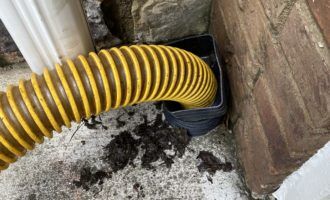
Properly draining the water that comes off your roof and into your downspouts is an important thing to get right.
Because of this need there are and have been many options to drain the water into or away from your property. One of the most common is with underground black pipes or drains that run either on the top of the ground or underneath the ground.
Here we share the things about cleaning these drains if they ever get clogged.
This article was resourced by a Gutter Cleaning Company in Buford GA
THANK YOU TO THE FOLKS AT
Guru Gutter Cleaning Buford (470) 280-1001
Visit Guru Gutter Cleaning Buford
Why Do Underground Gutter Drains Get Clogged?
There are two main reasons why underground gutter drains get clogged. Both are preventable.
#1: You don’t have any gutter protection (AKA Downspout filters) so when the leafs and debris go into your gutters it ends up going down your downspouts and into your underground drains.
When this happens it often doesn’t end up leaving the underground drain. As more and more debris does this it clogs up your underground drain.
#2: Your underground drain is made of corrugated black plastic pipe that either has holes in it, cracks, or will crack in the future. When this happens roots can start to enter the pipe and grow thick inside of it.
If you have roots in your underground gutter drain pipes, then it is going to be pretty hard to clear them. In fact, almost impossible.
BUT in order to clear them it will often destroy the pipe.
How To Clean Underground Gutter Drains?
There are a couple options but non of them are guaranteed. Some can be done by a homeowner with basic supplies.
#1. HGet a strong garden hose that is long enough and stiff enough to jam down the pipe. When you do this make sure the hose is turned on. This can help break debris up in the drain. If you want, you can get a high pressure nozzle on the end to help (DIY version of a pipe water jetter)
#2: Use your hand and arm and reach down as and pull debris out. Honestly, this is often what is needed because a lot of times the debris is just at the top.
#3: Use a stick or rod to break debris apart.
#4: Buy a plumbers auger and try that
#5: Use a vacuum on one end and seal it trying to suck it out (A shop vac would be the recommendation
#6: Call a plumber, water jetter or gutter cleaning company to use professional tools. NOTE: None of these guys can guarantee it will unclogg and most of them will use tools that can ruin a corrugated plastic pipe.
WARNING
Black corrugated pipe isn’t that strong. A lot of the methods to clear drains are too strong for this landscape piping.
We recommend using hard and thick pvc pipe for underground drains because it will last longer and allow your to get them clear if they get clogged.
Pop-up emitters: how they work and how to clear one
A pop-up emitter is the round cap you see in the lawn at the far end of an underground downspout line. When rain fills the pipe, the water pushes the lid up and spills out across the grass; when the flow stops, the lid drops back down to keep out leaves, soil and animals. For that to work, the emitter has to sit lower than the point where the pipe starts at the downspout, so the water can push up to it.
Because the pipe has to fill before the lid lifts, some water always sits in the line after a storm. Grit and fine debris settle out in that standing water, often in the elbow just under the emitter. Grass grows over the lid, mowers chip it, and soil and mulch wash onto it until it no longer opens.
To clear one, unscrew or pull off the emitter cap, scoop out the sand and silt below it, and run a hose into the downspout end until clean water flows out at the emitter. Trim the turf back from the lid, replace a cracked cap, and keep mulch and soil from piling up around it so it has room to open.
Downspout extensions and diverters
Not every downspout needs to go underground. Above-ground extensions carry water away from the foundation and are easy to see and clear. They come as straight or flexible pieces that clip onto the downspout elbow, hinged sections that flip up out of the way for mowing, splash blocks that spread the flow, and roll-out sleeves that unroll when water runs and curl back up when it stops.
How far the water needs to go depends on the yard. The goal is to drop it where the ground slopes away from the house, so it cannot run back toward the foundation. Extensions get kicked aside, crushed by mowers and buried in mulch, so check them after big storms.
A downspout diverter is a fitting cut into the downspout that sends water one of two ways, most often into a rain barrel or on down to the usual drain. Most have a flap you set by hand, and many send water back down the downspout once the barrel is full. Make sure the barrel's own overflow is also aimed away from the house.
French drain vs underground downspout drain
The two look alike in a trench but do opposite jobs. An underground downspout drain is a closed pipe that carries roof water from a downspout to an outlet such as an emitter, the curb, a dry well or a lower part of the yard. It should be solid, smooth-walled pipe, so the water stays inside until it reaches the end.
A French drain collects water from the soil. It is a gravel-filled trench with a perforated pipe, usually wrapped in filter fabric, that gathers groundwater or surface water along its length and carries it away. It is used along foundations, at the foot of slopes and in soggy parts of a yard.
Many drainage contractors keep the two separate. Tying downspouts into a French drain sends a heavy rush of roof water, along with grit and debris, into a system built to take in water slowly. The gravel silts up, the pipe overloads, and water can soak into the ground right where you were trying to dry it out. Where either kind of water may be sent can also be set by local rules, so check before tying into a street or storm drain.
Underground downspout clogged? How to find the blockage
Start at the top. Pull the downspout off the pipe where it enters the ground and look in with a flashlight; leaves, nests and balls of shingle grit are often right there. Then run a garden hose into the pipe. If water backs up almost at once, the clog is close. If the pipe takes water for a while and nothing comes out the far end, the clog is farther along.
Feed a drain snake, or a long hose with a jet nozzle, in from whichever end is closer to the clog, and note how far it goes before it stops. That distance tells you where to dig if it comes to that. For long lines, plumbers and drain companies can push a camera through to show whether the problem is debris, roots or a crushed section.
When you repair or replace a line, add a cleanout: a capped fitting near the downspout that opens straight into the pipe. A strainer or filter where the downspout meets the pipe keeps most leaves out. Together, those turn the next clog into a quick job instead of a shovel job.
Questions people ask
Why is my pop-up emitter not opening?
Usually something is holding the lid down or the water cannot reach it: grass or soil over the cap, a clog in the line, a crushed pipe, or an emitter set higher than the downspout inlet. Pull the cap, clear the grit beneath it and run a hose from the top to test.
How far should a downspout extension go from the house?
Far enough that the water lands on ground sloping away from the foundation and cannot run back. Many yards need several feet; flat lots, or lots that tilt toward the house, need more or an underground line. Watch where the water goes in a heavy rain.
Can you connect downspouts to a French drain?
It is often advised against. Roof water arrives fast and carries grit, which can overload a French drain and silt up its gravel, while the drain lets water into the soil you wanted dry. Most installers run downspouts in their own solid pipe.
Should underground downspout pipe be solid or perforated?
Solid. Its job is to carry roof water away, and perforated pipe lets water leak out along the way, often near the house, while letting soil and roots in. Smooth-walled pipe is also easier to clear than corrugated.
This guide was updated in October 2026 with new sections and the questions people ask most.
Gutter cleaners near you
Papalocal lists 23,203 gutter cleaners. Search them by town.
Related guides
All gutters guides

Your business? Claim it free