
Estimates and Squares: How Many Shingles Will I Need?
RRoofpedia guide1,335 words · 6 min read
Roof calculator
How many shingles will I need?
Roofers sell by the square: 100 square feet of roof.
- Roof area
- –
- Pitch factor
- –
- Bundles (3 a square)
- –
A starting number, not a quote. Ridge caps, starter strip and valleys add more. A roofer measures it for real.
A roofing square is 100 square feet of roof surface, and most asphalt shingles come three bundles to a square. To find how many you need, measure the roof's true area including pitch, divide by 100, add waste for cuts, and then add starter and ridge pieces, which are sold separately by the linear foot.
Save Money, Measure Better

Hi, my name is Robert Kinghorn & I am a roofing contractor in Newnan, GA. Here is a quick article to help you out.
If you're a roofer or a DIY'er you want to know exactly how much material you'll need on a given job. Specifically you want to be as close as humanly possible so you have very little leftover material. The average trip fee just to pick up more shingles probably costs an hour in lost time, and $20 in gas!
Here are some tips and trick on how to get the most accurate estimates for your roofing jobs.
Eagleview
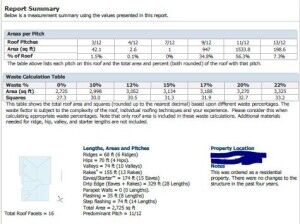
1. Eagleview. If you’re not using Eagleview technologies you’re missing out. They provide a detailed report of EVERYTHING you can think of on a roof, including the number of squares, and linear feet of rakes, eaves, and even valleys. The reports vary in cost, also depending how often you order from them, but they save boatloads of time and make your measurements EXACT.
Eagleview will also break down the roof by facets, protrusions, and even has an option to get exact measurements for the walls if you’re doing a siding job.
Eagleview however will not and cannot tell you some crucial items:
Whether or not the chimney has a cricket.
How many pipe jacks/vents there are and what size each penetration is.
If there are valley metals.
If drip edge and gutter apron are present.
If the chimney or siding has or needs flashing.
You’ll need to have someone on site and on the roof to take photos and measurements of those particulars.
Apps: Work Smarter, Not Harder
2. Using an app like roofingcalculator.org or dozens of others like the one at Better Homes & Gardens will give you an immediate break down of how many bundles of shingles are needed once you enter the number of squares from your Eagleview.
Bundles of Shingles
3. In terms of ordering shingles themselves, roof shingles are sold by both the bundle and estimated by the square. 1 square of shingles is the amount needed to cover 100 sq. ft. of roof. Shingles come in wrapped bundles designed to be light enough for a person to carry, so heavier shingles require more bundles per square.
Three bundles to a square is most common, which applies to most three-tab strip shingles and laminated shingles. When shingles are three bundles to the square, there are 29 standard-sized shingles (12 in. by 36 in.) in each bundle. Unless you’re installing a extremely high grade shingle (e.g. Owens Corning Berkshire which are 360 lbs a square) you should be fine.
Here’s the actual math: To determine the number of squares on a roof, divide its total # of square feet by 100. An average roof size is about 30 squares so (3,000 ÷ 100 = 30). This means you would need 30 squares of shingles to replace that roof. The most common type of shingle, called a three-tab or strip shingle, is generally packaged three bundles per square so you would need about 90 bundles.
Happy Measuring!
Resources
Roof pitch calculator: rise, run, multiplier and angle
Pitch is written as rise over a run of 12 inches: a 6/12 roof climbs 6 inches for every 12 inches across. A roof pitch calculator turns that into the two numbers you need, the angle and the multiplier that converts flat footprint area into true roof area. Some common ones: 4/12 is about 18 degrees with a multiplier near 1.05; 6/12 is about 27 degrees and 1.12; 8/12 is about 34 degrees and 1.20; 10/12 is about 40 degrees and 1.30; and 12/12 is 45 degrees and 1.41.
You can find the pitch without going into the attic. From a ladder at the gable end, hold a level dead level with one end touching the underside of the rake board, mark 12 inches along it, and measure straight up from that mark to the board. A phone level app can read the angle if you rest the phone on the rake trim or a shingle; convert degrees back to pitch with the list above.
Check more than one spot. Many houses mix pitches, with a steeper main roof and shallower porches or additions, and each section needs its own multiplier.
How many squares is my roof? Measuring from satellite images
Free map tools with a measuring feature, such as Google Earth, let you trace your roof outline from above and read off the area. That number is the roof's flat footprint as seen from the sky, and it already includes the overhangs because you are tracing the roof edge, not the walls. Multiply each section by its pitch multiplier, then divide by 100 to get squares.
Satellite tracing works well on simple roofs and goes wrong in a few predictable ways. Trees and shadows hide edges. Older images may predate an addition. Dormers and upper roofs that sit on top of lower ones are easy to miss or count twice. And the image can't show pitch, so a wrong guess there throws off the whole total.
To order materials, roofers often buy an aerial measurement report like the one this guide describes, or fly a drone that builds a 3D model and reports each facet, its pitch and its edge lengths. Use your own satellite number as a check on a quote: if a contractor's square count is far above yours, ask them to show how they measured.
Roofing calculator mistakes: waste, starter and ridge
A roofing calculator is only as good as what you feed it, and the most common error is the waste factor. A simple gable roof with long straight runs wastes little. A hip roof wastes more, because every hip is cut on an angle from both sides, and a roof full of valleys, dormers and short runs wastes more still. Use a bigger allowance for a cut-up roof rather than one figure for every house.
The second error is leaving out the edges. Squares count the field shingles only. Starter strip runs along every eave and rake, and hip and ridge caps run along every hip and ridge; both come in bundles rated for a set number of linear feet, printed on the wrapper. Measure those edges in feet and order them separately.
Then the rest of the list: underlayment rolls rated by the squares they cover, leak barrier for eaves and valleys, drip edge in fixed lengths, step flashing for walls, pipe boots, vents and nails. A calculator that only returns a bundle count has left out a good part of the order.
Questions people ask
How many bundles of shingles are in a square?
Most 3-tab and architectural shingles come three bundles to a square, so one square takes three bundles. Heavier designer shingles can take four or five. The wrapper states the coverage per bundle, so check it rather than assuming.
How many square feet does a bundle of shingles cover?
When a product is packed three bundles to a square, each bundle covers about 33 square feet, a third of a 100 square foot square. Products packed four or five to a square cover less per bundle. The exact coverage is printed on the bundle.
How do I convert roof square footage to squares?
Divide the roof's true surface area, after applying the pitch multiplier, by 100. A roof with 2,400 square feet of surface is 24 squares. Then add the waste allowance before you order shingles.
Is a roofing calculator accurate enough to order shingles?
For a ballpark, yes. For an order, check its inputs against a tape-measured or aerial-measured roof, use a waste factor that matches how cut up the roof is, and add starter, ridge and accessories, which many calculators leave out.
This guide was updated in October 2026 with new sections and the questions people ask most.
Roofers near you
Papalocal lists 57,560 roofers. Search them by town.
Related guides
 How Much Does A New Roof Cost?
 Solar Roof Shingles
 Types of Roofing Shingles
Your business? Claim it free on Papalocal